Day 7: Helen Garner, Elizabeth Hardwick, Lucy Dougan
Two Australian ones today, and another from Elizabeth Hardwick who is just really good.
Story: Helen Garner - Little Helen's Sunday Afternoon
I was surprised at how revolting and gruesome this story was. It starts out like any Helen Garner story: a low-key slice-of-life anecdote, where here a little girl visits the house of a family friend with her mum. The girl is left unsupervised and the story quickly takes a sharp turn into the disquieting and then outright horror in which the girl discovers that the world is full of evil.
Although it is third-person perspective, you are kept as naive and innocent as the character, which only reveals the meaning of things bit by bit, and as things become alarming, you start to fill in the gaps and predict what will happen, expecting the worst. I won't spoil the main plot points other than that I found them both surprising and horrible.
What makes the story memorable are the nightmarish descriptions that come from the girl not having adequate vocabulary for what she is seeing. The boy's face looks like "boiled custard"; the smell of the shed is "not just sweaty but raw, like steak" and another girl's hair is "stiff, like burnt grass".
This is one of the more unpleasant short stories I have read. I am not sure if I recommend it to anyone uninterested in suburban gothic horror, but I do recommend Helen Garner overall as one of the best living Australian writers.
Essay: Elizabeth Hardwick - The Art of the Essay
I fuckin loved this!!!!!!
I am hesitant to use the word awesome as it reminds me too much of its overuse in the late 2000s, but still, this is the word that comes to hand when I think about this essay. Elizabeth Hardwick, one of the very best essay writers, answers the difficult questions: what is a (non-academic) essay, and what makes a good one?
I recommend this to anyone who writes non-fiction. It is not available online sadly, but can be found in the NYRB's Uncollected Essays of Elizabeth Hardwick (2022) which you can buy, or download from the anna's archive.
Poem: Lucy Dougan - Why You Stopped Making Things
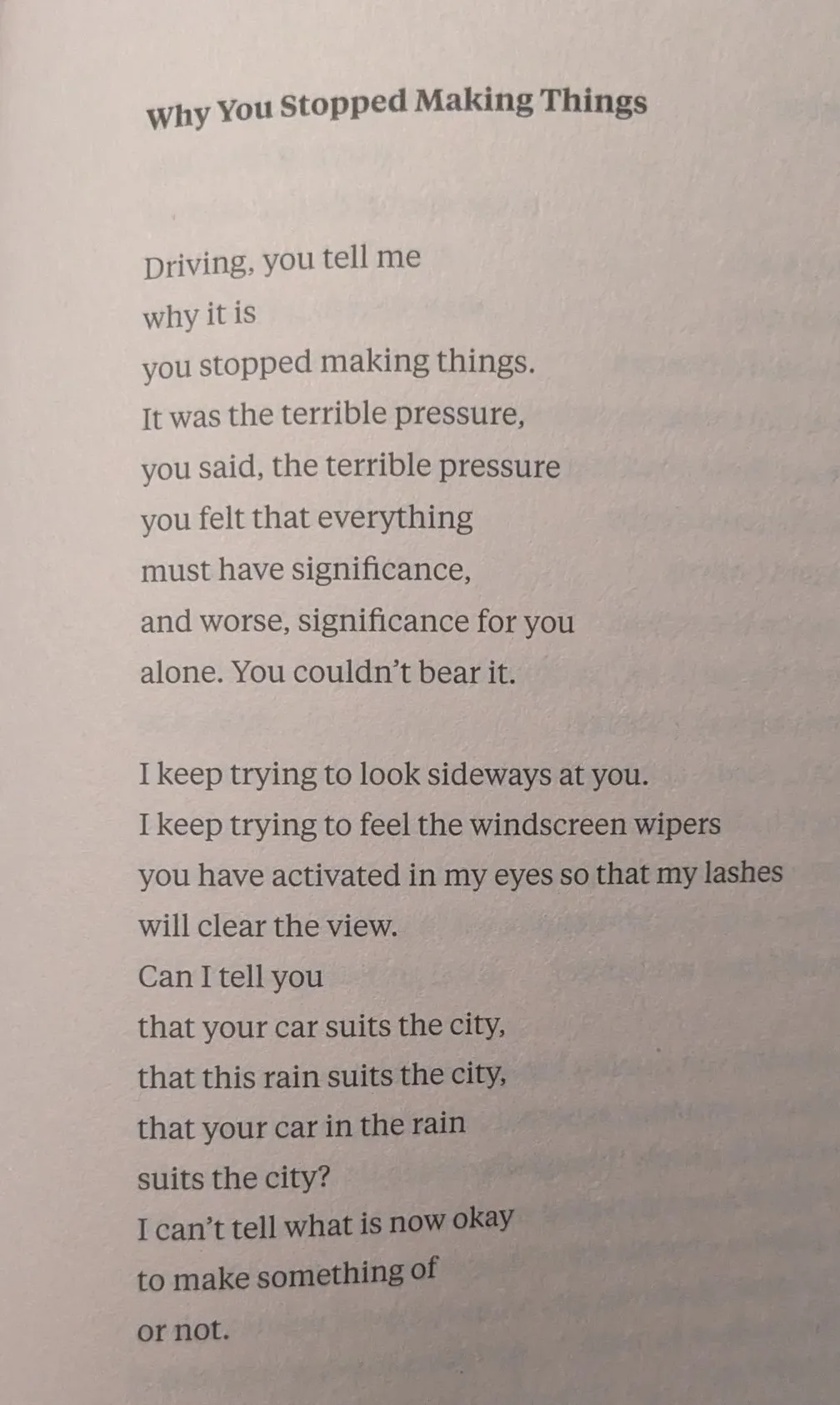
There are too many reasons why people stop making things, all of them severely heartbreaking.
This is a very empathetic poem- I love that it brings the narrator to tears. For anyone who defines themself by making things, the decision to stop for good is like a form of suicide.
I think where Lucy Dougan, the poet, and the other character in the poem differ is in their definition of significant.
All Dougan's poems in this collection could be said to revolve around insignificant things: a chair on the roadside, a secondhand Paul Frank monkey bag, a horse figurine, a discontinued shade of lipstick. All of these feel like strange subjects for poetry, yet Dougan connects them with a personal significance so powerful they feel universal.
The other character did not stop because he no longer found any personal significance in things, but because of the "terrible pressure" to do so, which is possibly the same thing.
The narrator wants to suggest that his car and the rain, those things immediately at-hand, could be significant enough to make something about, but then she second-guesses herself, possibly identifying with the other's anxieties about "significance" too much, the last lines reading: "I can't tell what is now okay to make something of or not."
It took me until I started writing this response that I understood the weird syntax of that last line. There is something to be said of understanding-by-doing, of following a hunch and trusting your own momentum. Worrying about an idea's significance before you begin only leads to creative inertia.